
MySQL vs. PostgreSQL for Data Analysis: Which Engine Should Power Your Next Project?

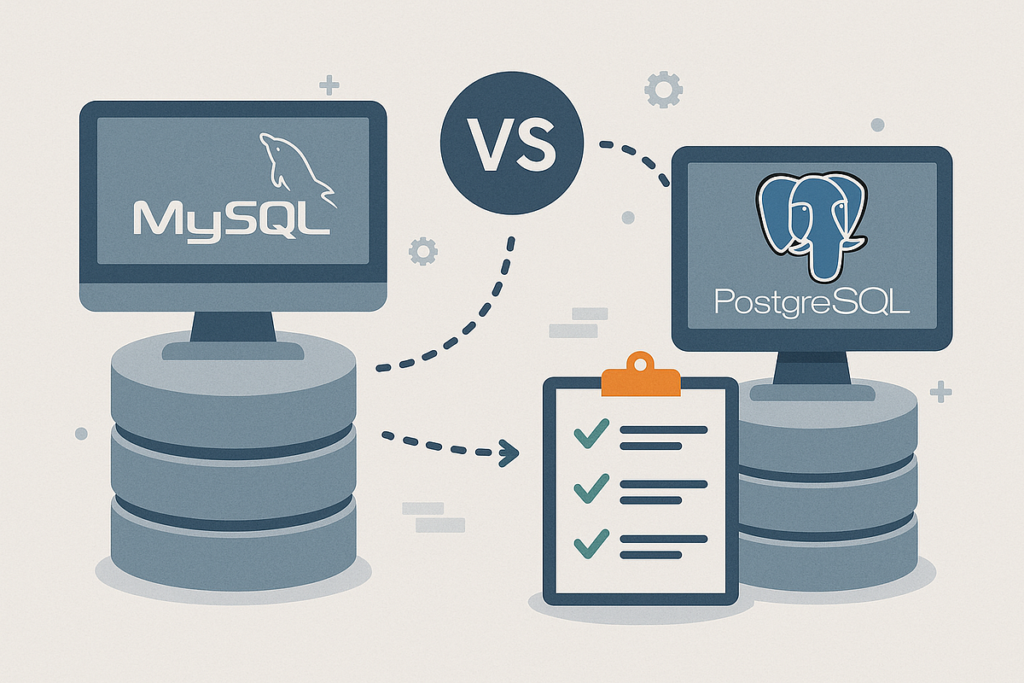
In today’s data-driven world, choosing the right database engine isn’t just about storing data — it’s about enabling powerful analysis, delivering insights quickly, and scaling with your future needs. Two of the most popular relational database systems — MySQL and PostgreSQL — each bring strengths and trade-offs. For data analysis workloads, the right choice can make a significant difference. Let’s explore how they compare, and which might be the better fit for your next analytics project.
1. Architecture & Concurrency: How They Handle Data
PostgreSQL is an object-relational database, offering deep support for advanced data types (arrays, JSONB, ranges) and a rich extension ecosystem. It uses Multiversion Concurrency Control (MVCC) natively, which means read and write transactions don’t block each other — a big plus for analytic systems with concurrent workloads.
MySQL, especially using its InnoDB engine, is simpler in design. It’s optimized for fast reads, thanks to its locking and caching mechanisms. However, because its MVCC is engine-dependent (InnoDB) and locking can be more aggressive, very high-concurrency write workloads may hit contention.
Implication for Analytics: For complex analytics workflows — especially those involving heavy writes or frequent concurrent updates — PostgreSQL tends to be superior. For mostly read-heavy reporting use cases, MySQL’s simpler architecture may suffice.
2. Data Types, Extensibility & SQL Features
One of PostgreSQL’s biggest advantages in the analytics space is its rich set of data types: beyond the basics, it supports arrays, enumerated types, JSONB, geometric types, and even custom types. Its extensibility is also powerful — users can define custom functions (even in Python), create their own data types, and leverage extensions like PostGIS for geospatial analytics.
Indexing in PostgreSQL is especially sophisticated: it supports B-tree, GIN, GiST, BRIN, expression indexes, partial indexes, and more. These capabilities allow for fast querying even over large, complex datasets.
MySQL supports standard data types (numeric, text, date/time) and JSON (from newer versions), but its indexing options are more limited in comparison. Its simplicity is an advantage — but for analytics workloads requiring complex queries or specialized types, MySQL’s flexibility may fall short.
3. Query Performance & Optimization
For read-heavy systems (e.g., dashboards, content management), MySQL often delivers excellent speed. Its design, especially with InnoDB, is highly optimized for repeated reads.
On the other hand, PostgreSQL shines when it comes to complex queries — joins, window functions, aggregations, Common Table Expressions (CTEs), and parallel query execution are all first-class citizens. Its advanced query planner makes it capable of optimizing sophisticated analytics workflows.
Benchmarking also supports this: according to Airbyte, PostgreSQL completes read operations ~1.6× faster than MySQL on average in certain workloads, and its write performance also outpaces MySQL significantly in write-intensive scenarios.
4. Scalability, Reliability & High-Availability
PostgreSQL provides robust support for large-scale systems: its MVCC-based concurrency, partitioning, and a powerful WAL (write-ahead log) system ensure data durability and strong performance even as datasets grow. Extensions like Citus can add horizontal sharding for true distributed scaling.
MySQL also supports replication and high-availability setups — with its binary log replication, ProxySQL, and clustering tools (like Vitess) enabling horizontal scaling. However, in very write-heavy, concurrent transactional workloads, MySQL’s locking can become a bottleneck.
5. Data Integrity, Compliance & Security
For analytics applications that require strong ACID (Atomicity, Consistency, Isolation, Durability) guarantees, PostgreSQL is often preferred — its default implementation assures all ACID properties. It also supports advanced security features like row-level security (RLS), fine-grained permissioning, and encryption.
MySQL with InnoDB is ACID compliant, but its concurrency model and locking strategies differ, which can affect consistency under heavy write operations. Its security model is solid for many applications, though advanced row-level policies are more mature in PostgreSQL.
6. Cost, License & Community
- Licensing: PostgreSQL uses a permissive open-source license (PostgreSQL License), allowing broad use, even in commercial settings. MySQL is GPL-licensed for its community version, but commercial licensing is also offered by Oracle.
- Community & Ecosystem: PostgreSQL has a strong, growing open-source community, rich documentation, and many third-party extensions. MySQL also has a vast ecosystem and long-standing adoption, but opinions vary on how Oracle’s stewardship affects its direction.
7. Use Cases: Which Engine Suits What Kind of Analytics Project
Here are some real-world guidance scenarios for picking between them in analytics:
| Scenario | Recommendation |
|---|---|
| Data Warehousing / BI / Analytics Platform | PostgreSQL — ideal for complex queries, large datasets, and analytics-focused workloads. |
| Real-Time Analytics with Mixed Read-Write | PostgreSQL — thanks to MVCC and parallel execution, it handles concurrency better. |
| Reports / Dashboards (mostly Reads) | MySQL — if your workload is relatively simple and read-heavy, MySQL can deliver fast performance with minimal complexity. |
| Geo-analytics or Specialized Data Types | PostgreSQL — with PostGIS, JSONB, ranges, and custom types, it’s more flexible. |
| Startups / MVPs / Simpler Apps | MySQL — Easier to set up, lighter, and enough for many early-stage analytics needs. |
8. Trends & Future Direction
- Growing Preference for PostgreSQL: Developer surveys suggest that PostgreSQL’s popularity continues to rise, particularly among professionals dealing with data-intensive applications.
- Modern Data Stack Integration: Many modern data tools (ELT platforms, transformation tools, BI stacks) increasingly optimize for PostgreSQL as a storage or query engine.
- AI + SQL: Emerging research (e.g., AI for query optimization on PostgreSQL) shows how intelligent systems are being built around PostgreSQL to simplify analytics for non-technical users.
9. Conclusion & Recommendation
If your next project involves serious data analysis, complex queries, and scalability, PostgreSQL should be your leading contender. Its advanced SQL features, extensibility, and performance under concurrency make it very well-suited for analytics workloads.
However, MySQL should not be dismissed — especially if your analytics needs are simpler, your project is read-heavy, or you need a lightweight engine with proven stability. For many web-based dashboards or smaller analytical apps, MySQL remains a solid, efficient choice.
📞 Ready to Start Your Data Journey?
Unlock your potential with Jozial – where data meets opportunity.
Join thousands transforming their careers with Python, Pandas, ML & more.
📲 Phone: +91 97867 12021
🌐 Website: www.jozial.com
📍 Centres: Chennai | Coimbatore | Kumbakonam
Learn smart. Learn now. Learn with Jozial. 🚀



Leave a Reply